Over the past three years, I’ve had a great opportunity to review tens of research papers applying machine learning to geotechnical problems: slope stability, soil classification, predictive modeling, you name it.
And while I genuinely appreciate the effort researchers put into these studies, I’ve noticed a pattern:
Many of them are just chasing the AI/ML buzzword rather than actually solving a problem.
Now, I know that’s a bold claim. But hear me out.
I keep seeing overcomplicated models built on tiny datasets as if the goal is to use the most complex algorithm possible rather than to produce a reliable, generalizable solution.
I once came across a paper where someone built a three-layer artificial neural network (ANN) on just 15 data points with three or four features. Fifteen data points! That’s like trying to predict the stock market based on a week of prices.
The result? Massive overfitting.
What’s Overfitting?
Overfitting happens when a model is so complex that it learns every little detail and noise in the training data, but then completely fails on new, unseen data. It’s like memorizing the answers to a test instead of actually understanding the subject.
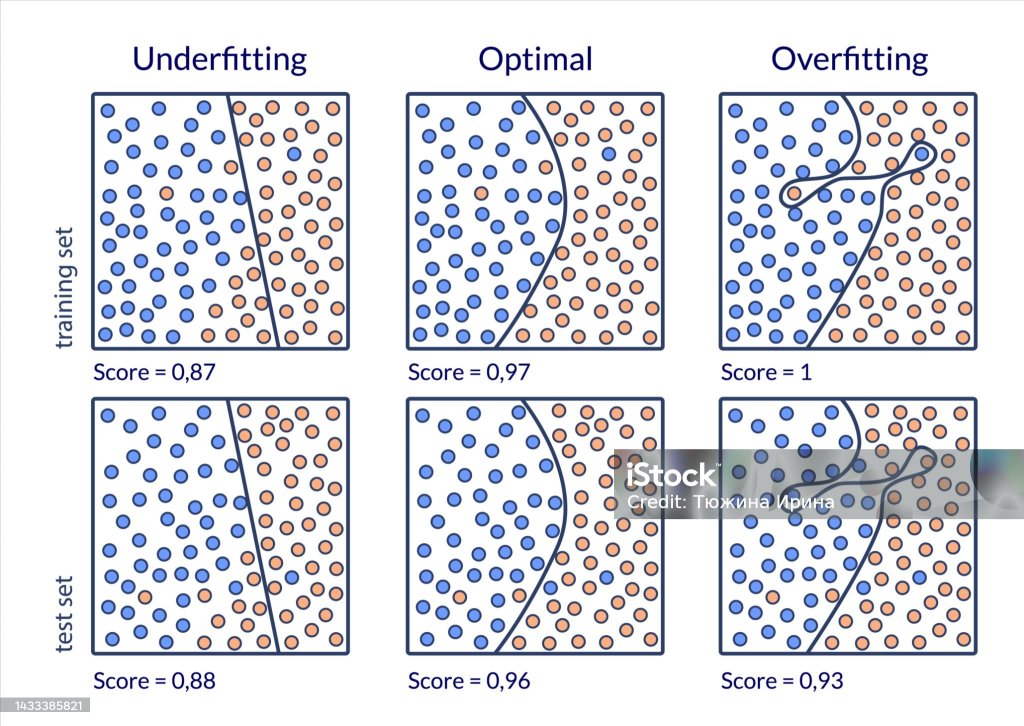
In geotechnical engineering, where data is most probably limited, overfitting is a serious problem. If your model isn’t generalizable, it’s useless, it’s not helping engineers make better decisions in the field, and it certainly isn’t advancing the profession.
So when I see an ANN with 100 neurons trained on 15 data points, I can’t take that seriously. Sorry, but that’s not solving anything!
What Should We Do Instead?
First, start with data integrity (I wrote an entire post about this, check it out in the link below1). If your data isn’t solid, no ML model, no matter how fancy, can save you.
Second, think about bias-variance tradeoff (I know, more vocabulary, but stick with me).
- Bias: When your model is too simple, it misses patterns in the data.
- Variance: When your model is too complex, it memorizes noise instead of learning real relationships.
A good model balances both—it’s complex enough to capture real trends but simple enough to generalize beyond the training data.
Bottom Line
Before chasing the model, its better to check:
1- Is my data reliable?
2- Does my model generalize?
3- Am I solving a real problem, or just trying to make my model sound cool?
A simple, well-calibrated linear model is far more valuable than an ANN that overfits and tells us nothing useful. And just to be clear, I have nothing against ANNs (I actually love them!), but only when they make sense.
We don’t need sexier model names. We need better models that actually work.
What do you think? Have you seen this problem in geotechnical ML research?
 STAIGES: Insights
Leave a comment