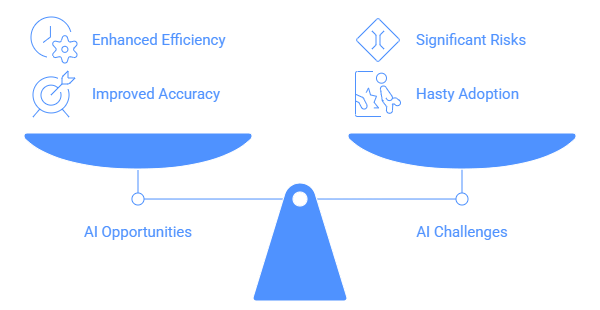
When I started this newsletter, my original goal was simple: share insights from my research on machine learning applications in geotechnical engineering and explore how these tools could improve engineering practice.
But over the past year, the landscape changed rapidly
With the rise of Large Language Models (LLMs), technical information has become more accessible than ever. Engineers are already using AI tools to generate useful code, automate workflows, and even build small applications for daily tasks. In many ways, the barrier to entry is disappearing.
So I started asking myself an important question:
If AI can already generate the information, what is the role of this newsletter?
After thinking about it for a while, I realized the answer is not to chase every new AI trend or tool release.
It is to step back and focus on the foundations.
Because while AI tools are becoming incredibly powerful, using them effectively in engineering still requires judgment, technical understanding, and the ability to recognize when something is wrong.
And in geotechnical engineering, that matters.
A confidently generated answer is not necessarily a reliable one. A useful-looking script is not automatically repeatable or technically sound. And “vibe coding” an application without understanding the assumptions behind it can create more risk than value.
That is why I believe the future belongs to engineers who combine domain expertise with strong technical foundations.
For me, the building blocks of an AI-ready geotechnical engineer look something like this:
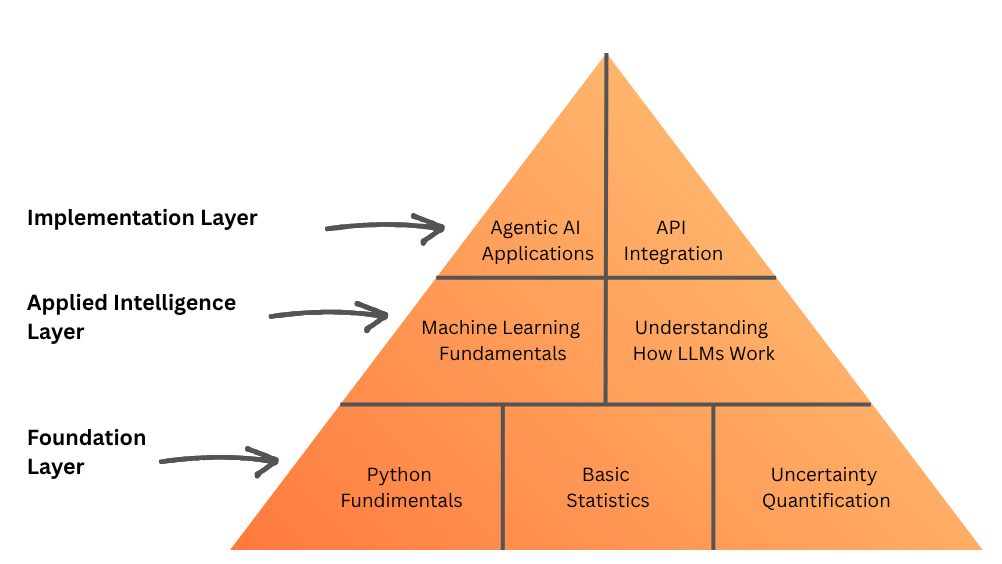
The reason I structured it this way is intentional.
Before jumping into advanced AI tools, geotechnical engineers might need a solid foundation in programming, statistics, and uncertainty quantification. For me, these are not optional skills anymore. They are becoming part of modern engineering literacy.
In my opinion, an engineer who understands Python, probabilistic thinking, and uncertainty quantification can use AI as a powerful accelerator.
But an engineer who blindly applies generated code without understanding what it does may end up creating workflows that are difficult to verify, reproduce, or trust.
That distinction will matter more and more in the coming years.
So this is the direction of the newsletter going forward.
So, what’s next?
In the next issue, I’ll start with Python fundamentals specifically for geotechnical engineers, practical concepts, practical workflows, and examples that can immediately improve day-to-day engineering tasks.
Later on, I’ll also share machine learning applications, automation ideas, and practical AI workflows that I believe can genuinely save engineers time and improve decision-making in practice.
As for statistics and uncertainty quantification, there are already many excellent free resources online, so I may focus less here and more on connecting these concepts to real geotechnical engineering problems.
Ultimately, my goal is to build a community of geotechnical engineers who are genuinely interested in the future of AI in our field, not just the hype, but the engineering thinking behind it.
If you have thoughts about this direction, I’d genuinely like to hear them. Feel free to comment, reply, or send me a message.
I think the next decade of geotechnical engineering will look very different from the last one, and I’d like this newsletter to be a place where we think through that future together.
Thanks for reading, and I’ll see you in the next issue!
Laith


Leave a Reply